The Rugged Evolution of Miniature Off-Road Machines
From backyard dirt piles to professional racing circuits, miniature off-road vehicles have undergone a remarkable transformation, blending childhood imagination with cutting-edge engineering.

The progression from simple wind-up toys to sophisticated remote-controlled machines demonstrates decades of engineering innovation.
From Simple Beginnings to Complex Systems
The journey of toy off-road vehicles began with basic mechanical designs in the mid-20th century. According to HobbyTron's historical archives, early models were primarily wind-up or battery-operated toys with limited functionality. These initial designs focused on basic movement rather than terrain capability, serving as simple entertainment rather than performance machines.
The 1970s marked a significant turning point with the introduction of radio-controlled (RC) technology. RC Groups technical documentation reveals that early RC systems operated on 27MHz frequencies with limited range and reliability. These systems, while revolutionary for their time, suffered from interference issues and basic control mechanisms that restricted their off-road capabilities.
Key Technological Milestones
- 1979: Introduction of proportional steering systems
- 1985: Development of oil-filled shock absorbers for scale models
- 1992: First digital proportional radio systems
- 2005: Brushless motor technology becomes mainstream
- 2015: Integration of gyroscopic stabilization systems
Engineering Precision in Miniature Form
Modern toy off-road vehicles represent a convergence of multiple engineering disciplines. Engineering.com's analysis highlights how these miniature machines incorporate principles from automotive engineering, materials science, and electronics. Suspension systems, for instance, have evolved from simple leaf springs to sophisticated multi-link designs with adjustable damping and preload settings.

Advanced suspension systems enable precise terrain handling in miniature scale.
The chassis design represents another area of significant advancement. Early models used simple plastic or metal frames, while contemporary designs employ space-frame constructions or monocoque designs similar to full-scale racing vehicles. According to Materials Performance research, modern toy off-road vehicles utilize composite materials including carbon fiber, aluminum alloys, and advanced polymers that provide optimal strength-to-weight ratios.
Drivetrain technology has seen parallel evolution. From basic gear systems to sophisticated differentials with locking capabilities, these components enable realistic off-road performance. RC Universe technical forums document how modern systems incorporate center differentials, torque vectoring, and electronic traction control systems that mimic their full-scale counterparts.
Digital Integration and Control Systems
The digital revolution has transformed how enthusiasts interact with toy off-road vehicles. Modern control systems operate on 2.4GHz frequencies with frequency-hopping spread spectrum technology, eliminating interference issues that plagued earlier systems. Digi-Key's electronics guide explains how these systems provide latency as low as 5 milliseconds, enabling precise control essential for competitive racing and technical terrain navigation.
Advanced Control Features
Telemetry Systems
Real-time data transmission including speed, temperature, battery voltage, and motor RPM provides valuable performance feedback.
Gyroscopic Assistance
Integrated MEMS gyroscopes help maintain stability during jumps and on uneven terrain, automatically adjusting throttle and steering inputs.
Programmable Controllers
Modern transmitters allow customization of throttle curves, steering sensitivity, and multiple model memory for different vehicles.
Battery technology represents another critical advancement. The shift from nickel-cadmium to lithium-polymer batteries has dramatically increased power density and reduced weight. Battery University research indicates that modern LiPo batteries provide up to three times the energy density of older technologies while supporting high discharge rates essential for powerful brushless motor systems.
Terrain Performance and Scale Realism
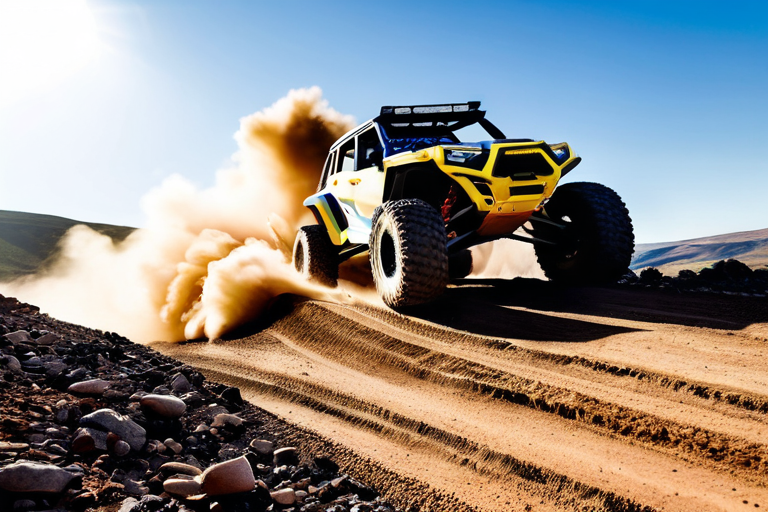
Modern miniature off-road vehicles demonstrate remarkable capability across diverse terrain types.
The pursuit of scale realism has driven significant innovation in tire and wheel technology. According to RC Car Action technical guides, modern off-road tires feature compound-specific rubber formulations, multi-density foams, and tread patterns optimized for specific terrain conditions. These developments enable realistic performance across mud, sand, gravel, and rocky surfaces.
Suspension tuning has become increasingly sophisticated, with adjustable camber, caster, and toe settings allowing enthusiasts to optimize handling characteristics for specific conditions. Team Associated's suspension guide details how these adjustments affect weight transfer, traction, and stability during aggressive maneuvers.
The Competitive Landscape and Community
Organized racing has played a crucial role in advancing toy off-road vehicle technology. Major competitions like the IFMAR World Championships drive innovation through competitive pressure. These events have led to developments in aerodynamics, weight distribution, and electronic speed control systems that eventually trickle down to consumer products.
Industry Impact
The toy off-road vehicle market has grown into a significant industry segment. Market research data indicates annual sales exceeding $1.2 billion globally, with growth driven by technological advancements and increasing adult participation. This economic scale supports continued research and development across electronics, materials science, and manufacturing processes.
Online communities and digital platforms have transformed how enthusiasts share knowledge and techniques. Platforms like RCTech forums and YouTube channels dedicated to RC technology have created global networks where innovations spread rapidly. This collaborative environment accelerates technological development and makes advanced techniques accessible to hobbyists at all skill levels.
Future Directions and Emerging Technologies
The future of toy off-road vehicles points toward increased integration with digital ecosystems. IEEE standards development indicates movement toward standardized communication protocols that could enable vehicle-to-vehicle communication and coordinated group maneuvers. Artificial intelligence integration represents another frontier, with potential applications in autonomous obstacle avoidance and adaptive performance tuning.
Augmented reality interfaces may soon enhance the driving experience, overlaying performance data and terrain information in real-time. SAE International technical papers suggest that these interfaces could provide virtual racing lines, obstacle highlighting, and performance analytics during operation.
Sustainable manufacturing practices are becoming increasingly important. The industry is exploring biodegradable composites, recycled materials, and more efficient production methods. Green Electronics Council initiatives highlight efforts to reduce environmental impact while maintaining performance standards.

Emerging technologies promise to further enhance the capabilities of miniature off-road machines.
Conclusion: Beyond Simple Playthings
The evolution of toy off-road vehicles represents a remarkable convergence of childhood imagination and advanced engineering. What began as simple mechanical toys has transformed into a sophisticated hobby combining electronics, mechanics, and materials science. These miniature machines continue to push technological boundaries while maintaining their fundamental appeal: the joy of conquering terrain in scaled-down form.
As technology advances, these vehicles will likely become even more integrated with digital ecosystems while maintaining their physical connection to the rugged terrain they're designed to conquer.