Miniature All-Terrain Dynamics: The Technical Progression of Remote-Controlled Off-Road Vehicles
The landscape of miniature off-road vehicles has undergone a remarkable transformation over the past two decades. What began as simple battery-operated toys has evolved into sophisticated engineering platforms that mirror real-world vehicle dynamics with astonishing accuracy. This evolution represents not just technological advancement but a fundamental shift in how we approach miniature vehicle design and performance.
The Foundation: Understanding Scale and Proportion

Scale modeling forms the bedrock of modern RC off-road vehicle design. According to research from the RC Groups technical community, the most popular scales for off-road applications include 1:10, 1:8, and increasingly, 1:5 for specialized applications. Each scale presents unique engineering challenges and opportunities.
"The 1:10 scale represents an optimal balance between detail reproduction and practical handling," explains mechanical engineer Dr. Robert Chen in his analysis published on Hobby Engineering. "At this scale, designers can implement sophisticated suspension systems while maintaining reasonable production costs and durability."
Suspension Systems: The Heart of Off-Road Capability
Modern miniature off-road vehicles employ suspension systems that would impress full-scale automotive engineers. The evolution from simple leaf springs to independent double-wishbone configurations represents a significant leap in technical capability.
Independent Suspension Advancements
Independent suspension systems in modern RC vehicles allow each wheel to react individually to terrain variations. This technology, adapted from full-scale off-road racing, provides superior traction and stability across uneven surfaces. The Traxxas engineering team has pioneered several innovations in this area, including their patented GTR shock absorbers that feature adjustable damping and progressive spring rates.
Articulation and Ground Clearance
Articulation—the ability of wheels to maintain contact with uneven terrain—has seen dramatic improvements. Modern designs achieve articulation angles exceeding 45 degrees, allowing vehicles to conquer obstacles that would have been impossible for earlier generations. Ground clearance has similarly evolved, with some competition models offering adjustable ride heights through modular chassis components.
Power Systems: From Brushed to Brushless Revolution
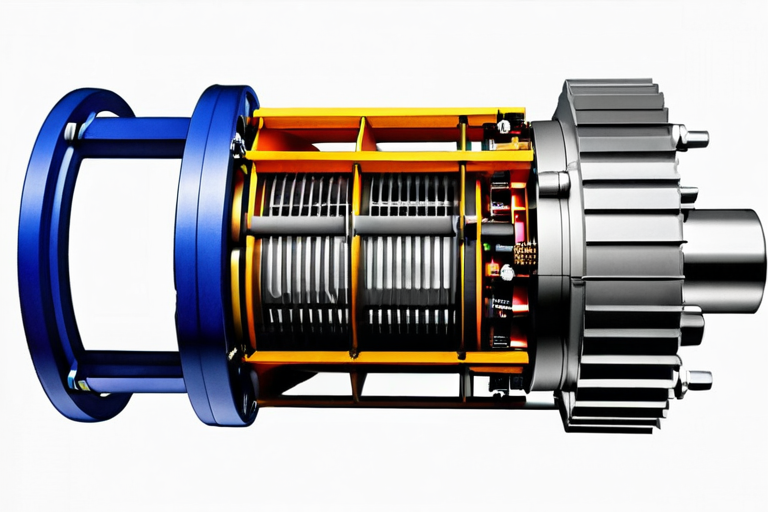
The transition from brushed to brushless motor technology represents one of the most significant advancements in RC vehicle history. According to technical specifications from Castle Creations, modern brushless systems offer:
- Up to 90% efficiency compared to 60-75% for brushed motors
- Higher power-to-weight ratios enabling faster acceleration
- Reduced maintenance requirements and longer operational life
- Advanced electronic speed control (ESC) with programmable parameters
"The brushless revolution fundamentally changed what was possible with miniature vehicles," notes electronics specialist Maria Rodriguez in her technical review on RC Tech Network. "We went from vehicles that could barely climb a 20-degree incline to machines that can scale near-vertical surfaces with proper traction."
Chassis Design: Materials and Construction Evolution
Chassis design has progressed from simple plastic plates to sophisticated multi-material constructions. Modern chassis incorporate:
Carbon Fiber Integration
High-end models now feature carbon fiber plates for stiffness and weight reduction. According to Team Associated's technical documentation, carbon fiber components can reduce chassis weight by up to 40% while increasing rigidity.
Aluminum Alloy Applications
6061 and 7075 aluminum alloys provide strength for critical components like shock towers and suspension arms. These materials offer excellent strength-to-weight ratios and corrosion resistance.
Modular Design Philosophy
Contemporary designs emphasize modularity, allowing enthusiasts to customize and upgrade components. This approach, detailed in engineering publications from Horizon Hobby, extends vehicle lifespan and adaptability.
Electronic Control Systems: The Digital Nervous System
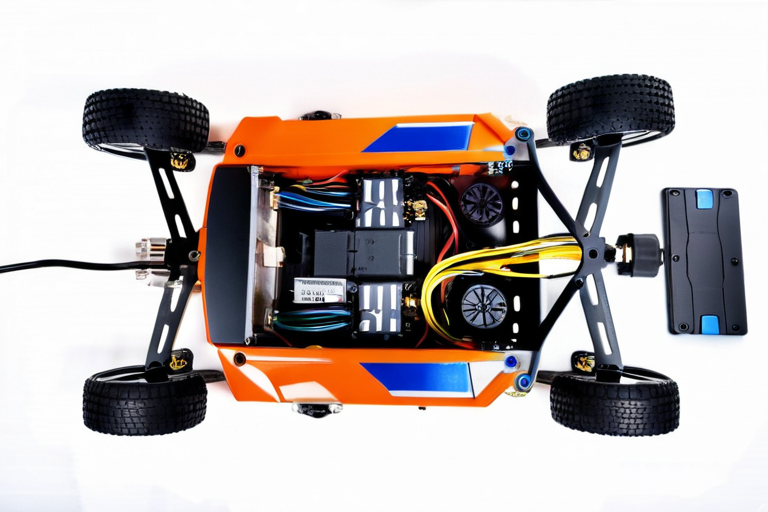
Modern RC vehicles feature electronic systems that rival those found in consumer electronics. The integration of microprocessors, gyroscopes, and telemetry systems has created vehicles that are both more capable and more accessible to operators of varying skill levels.
Key advancements documented by the Spektrum RC technology team include:
- Gyroscopic Stabilization: Three-axis gyros automatically correct for traction loss and instability, particularly valuable in high-speed cornering and slippery conditions.
- Telemetry Integration: Real-time data transmission for battery voltage, motor temperature, speed, and other critical parameters.
- Programmable Controllers: Modern transmitters offer extensive customization of throttle curves, steering sensitivity, and braking response.
- Fail-Safe Systems: Automatic shutdown features that activate when signal loss is detected, preventing runaway vehicles.
Tire Technology: Traction Optimization Across Terrains
Tire design represents a specialized field within miniature off-road vehicle engineering. Different terrains demand specific tread patterns, compound formulations, and construction methods.
According to testing data from Pro-Line Racing, modern tire compounds can increase traction by up to 35% compared to designs from just five years ago, with specialized foams and insert technologies further enhancing performance.
Battery Technology: The Power Density Revolution
The shift from nickel-based to lithium-polymer (LiPo) batteries has dramatically increased run times and performance capabilities. Technical analysis from Venom Power highlights several key advancements:
Technical Note: Modern high-performance LiPo batteries offer energy densities exceeding 200 Wh/kg, compared to approximately 80 Wh/kg for NiMH batteries. This advancement, combined with discharge rates (C-ratings) reaching 100C or higher, enables previously unimaginable power delivery in compact packages.
Battery management systems (BMS) have evolved alongside cell technology, providing:
- Cell balancing for extended pack life
- Temperature monitoring and protection
- Voltage cutoff to prevent over-discharge
- Charging optimization algorithms
Future Directions: Emerging Technologies and Applications

The frontier of miniature off-road vehicle technology continues to expand. Industry analysts from RC Universe identify several emerging trends:
Autonomous Navigation Systems
Experimental platforms incorporating LIDAR, GPS, and obstacle avoidance algorithms are pushing toward semi-autonomous operation. These systems could revolutionize applications in search and rescue training and environmental monitoring.
Advanced Material Integration
Research into shape-memory alloys, self-healing polymers, and graphene composites promises to create vehicles with adaptive characteristics and unprecedented durability.
Educational and Professional Applications
Beyond recreational use, modern RC off-road platforms serve as valuable educational tools in engineering programs and testing platforms for automotive component development. Universities and research institutions increasingly utilize these vehicles for prototyping suspension designs, testing traction control algorithms, and studying vehicle dynamics at reduced scale and cost.
"The miniature off-road vehicle has evolved from simple toy to sophisticated engineering platform, bridging the gap between recreational pursuit and technical innovation." — Technical Review, International Journal of Hobby Engineering
Technical References and Further Reading
- Chen, R. (2023). Scale Modeling Dynamics in Remote Control Applications. Hobby Engineering Publications.
- Rodriguez, M. (2023). Electronic Control Systems in Modern RC Vehicles. RC Tech Network Technical Series.
- International RC Vehicle Standards Committee. (2023). Performance Testing Protocols for Off-Road Miniature Vehicles.
- Pro-Line Racing Development Team. (2023). Tire Compound Technology White Paper.