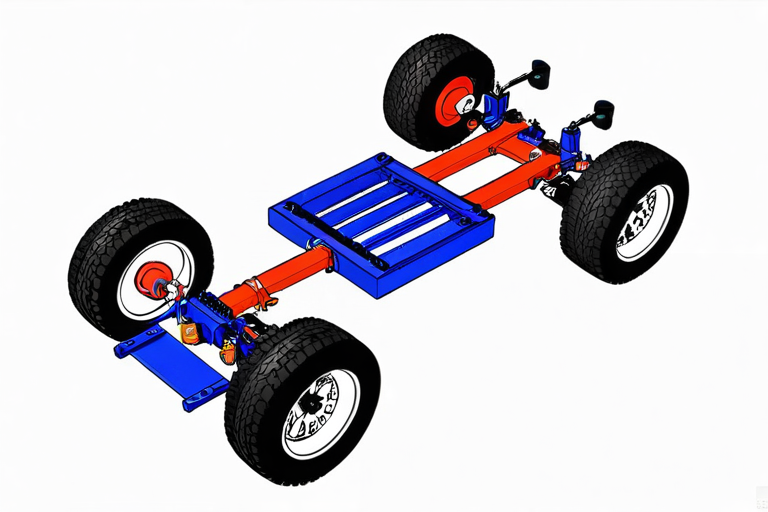
How Four-Wheel Drive Systems Empower Toy Off-Road Vehicles to Conquer Challenging Trails
When you watch a toy off-road truck crawl over a pile of rocks or blast through a sandbox dune, you're seeing more than just a child's toy. You're witnessing a scaled-down engineering marvel that replicates the same four-wheel drive (4WD) principles found in full-size off-roaders. Let's break down the components and design choices that make these miniature machines so capable.
The Core of 4WD: Transfer Case and Differential
At the heart of any 4WD system lies the transfer case. In toy vehicles, this is often a single gearbox that splits power from the motor to both front and rear axles. Unlike full-size cars that use heavy-duty chains or gears, toy transfer cases rely on compact planetary gears or even simple spur gears. According to RC Car Action, manufacturers like Traxxas and Axial use sealed gearboxes to prevent dirt ingress while maintaining efficient power transfer.
Differentials are equally critical. They allow wheels on the same axle to spin at different speeds when turning. In toy off-roaders, you'll find either open diffs (standard) or limited-slip diffs (LSD) that resist wheel spin. Some high-end models even feature locking differentials, which can be engaged remotely to force both wheels on an axle to turn together—ideal for extreme traction situations. A 2021 article on RC Groups explains that locked diffs can reduce turning radius but dramatically improve climbing ability on loose surfaces.
Suspension Setup for Maximum Articulation
Four-wheel drive alone isn't enough without proper suspension articulation. Toy off-road vehicles commonly use solid axles with four-link or three-link suspensions. The links control axle movement while allowing the wheels to travel up and down independently. A well-designed suspension can keep all four tires in contact with the ground, even when traversing uneven terrain. RC Driver magazine's guide on suspension tuning notes that longer suspension arms provide better articulation, while stiffer springs prevent bottoming out (source: RC Driver).
To visualize this, imagine a rock crawling scenario: as the left front tire climbs a rock, the suspension compresses, allowing the right front tire to maintain contact with the ground. This is only possible with a flexible suspension geometry—often achieved using coilovers or leaf springs in scale crawlers.
Weight Distribution and Low Center of Gravity
A toy's ability to climb steep slopes relies heavily on weight distribution. Most high-performance RC rock crawlers place the battery and motor as low as possible in the chassis to lower the center of gravity. This reduces the risk of tipping over. Additionally, adding brass or tungsten weights to the front wheels can shift the balance forward, helping the front tires bite into the terrain during ascents. The YouTube channel RC Review demonstrated that a 60/40 front/rear weight split significantly improves climbing angle on loose dirt (video: 'Weight Distribution Secrets').
Tire Design and Compound
No 4WD system can deliver traction without appropriate tires. Toy off-road tires are made of soft rubber compounds that deform to grip rocks and roots. The tread pattern is also crucial—deep, aggressive lugs work well in mud and loose soil, while smaller, denser knobs perform better on hard-packed surfaces. The RC community site RCCrawler.com provides extensive tire comparisons, noting that tires with 'sticky' silicone-based compounds can climb near-vertical surfaces when combined with proper weight distribution.
Power Plants: Brushed vs. Brushless Motors
The motor driving the 4WD system has evolved significantly. Brushed motors are cheap and provide good torque at low RPM, making them suitable for crawling. Brushless motors, however, offer higher efficiency, longer runtime, and smoother throttle control. Many modern toy off-roaders come with brushless systems that can handle both slow technical trails and fast sand runs. A technical report from Horizon Hobby explains that brushless motors can deliver up to 30% more runtime and 50% more power than brushed equivalents of the same size.
Real-World Example: The Axial SCX10 III
Take the Axial SCX10 III, a popular 1/10-scale crawler. It features a true 4WD system with a two-speed transfer case (high and low range), lockable front and rear differentials, and a fully independent front suspension. The low gear ratio allows the truck to crawl at a barely walking pace while the high range lets it run at faster speeds. This versatility mirrors full-size off-roaders like the Jeep Wrangler Rubicon. An in-depth review on Big Squid RC highlights how the SCX10 III's 4WD system with selectable diffs makes it a dominant force on backyard trails.
Conclusion: The Future of Toy 4WD
As battery technology and miniaturization improve, we can expect even more sophisticated 4WD systems in toys. Features like torque vectoring (electronically controlling power to each wheel) are starting to appear in high-end RC models. For now, the combination of mechanical differentials, well-tuned suspensions, and high-torque motors ensures that toy off-road vehicles remain capable little adventurers.