How Do Different Tire Treads Affect Miniature Off-Road Car Performance?
Imagine sending your toy off-road vehicle up a steep, sandy dune. It digs in, finds grip, and conquers the slope—then minutes later, it bogs down in a patch of loose gravel. The difference? Tire treads. In the world of remote-controlled and free-wheeling toy off-roaders, tire design is the silent hero that determines whether your miniature machine masters the terrain or spins out in frustration. While scale realism often guides manufacturers, the physics beneath those tiny knobs and grooves is surprisingly sophisticated. We’ll explore how tread patterns, rubber compounds, and tire dimensions interact to shape performance, drawing on insights from hobbyist forums like RC Car Action and engineering principles that apply to both full-size 4×4s and their pint-sized counterparts.
The Miniature Tire Dilemma
Toy off-road cars, whether electric RC models or simple push‑along trucks, face the same fundamental challenges as real vehicles—just at a fraction of the scale. Weight, torque, and ground pressure all shrink, but gravity and friction don’t care about size. A tiny tire’s contact patch might be no bigger than a penny, yet it must transfer the motor’s power to loose sand, slick mud, or jagged rocks without slipping. That’s where tread comes in. According to a detailed breakdown on Horizon Hobby, tread patterns are the number‑one factor in tailoring a vehicle to its environment, even more than horsepower in the 1/10 to 1/16 scale realm.
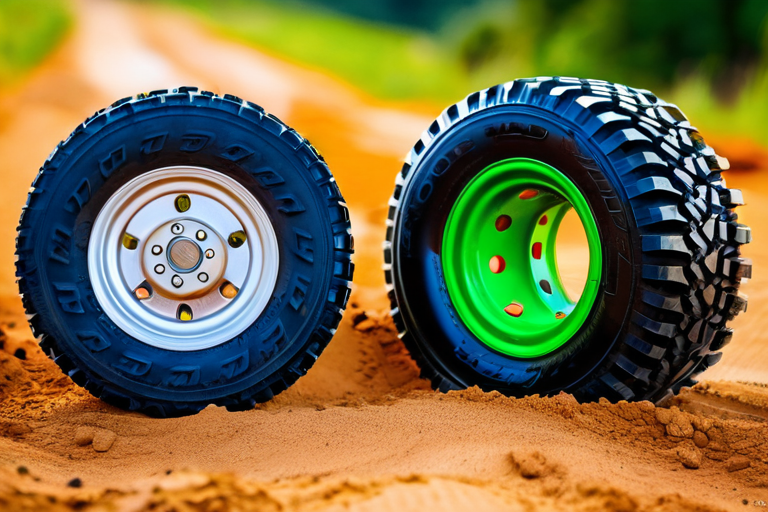
Breaking Down Tread Patterns
Not all tread is created equal. Let’s examine the most common patterns found on toy off-road vehicles, and what each does best.
Ribbed & Slick Treads: The Pavement Specialists
You’ll often see narrow, ribbed tires on entry-level remote-control cars meant for sidewalks or driveways. They minimize rolling resistance and noise, providing a smooth ride on hard, flat surfaces. However, as a Traxxas product guide notes, these tires become nearly useless once you leave the pavement—clay and grass quickly clog the shallow grooves, turning them into slicks. For genuine off-road play, you need something more aggressive.
Block & Directional Treads: The All‑Rounders
Blocky, square‑edged treads arranged in a directional pattern are the workhorses of the hobby. They strike a balance between forward bite and lateral stability, making them ideal for hard‑packed dirt, rocks, and short grass. The staggered blocks help the tire “clean” itself by ejecting debris as it rotates, a critical feature often highlighted by RC Planet tech articles. Many mid‑range hard‑shell RC trucks, like those from Redcat Racing, come equipped with this pattern because it performs adequately across varied conditions without excelling in any single one.
Paddle Tires: Sand Conquerors
When the terrain turns to loose sand or deep powder, paddle tires are king. These have long, curved ribs that act like spoons, digging in and pushing the sand backward to propel the vehicle forward. The physics is analogous to a paddle‑wheel steamboat. Enthusiast forums like RCGroups host countless threads debating the ideal paddle shape and spacing: too few paddles and you hop; too many and you dig yourself a hole. In the toy world, paddle tires are often optional upgrades, as they’re highly specialized and wear quickly on hard surfaces.
Chevron Tread: Mud Masters
Chevron‑style (V‑shaped) treads are the go‑to for muddy environments. The central V‑groove forces mud outward, continuously clearing the tread blocks so they can bite fresh ground. This self‑cleaning action is essential, explains a Mud4Fun off‑road blog, because mud that packs into the tread turns a tire into a heavy, ineffective slick. Many miniature off‑roaders designed for wet play feature deep chevron patterns to maintain grip when things get sloppy.
Pin & Spike Tires: Crawling Champs
For slow‑speed rock crawling, pin tires—covered in hundreds of small, flexible spikes—are unmatched. Each spike conforms to microscopic surface irregularities, creating mechanical interlocking that allows vehicles to cling to steep, smooth rock faces. Scale crawler enthusiasts on Axial Racing forums often replace stock tires with ultra‑soft compound pin tires to achieve near‑vertical climbs. The principle mirrors the adhesive forces geckos use, scaled up to visible rubber prongs.
Beyond Pattern: The Compound Matters
Tread design is only half the story. Rubber compound—the chemical formulation of the tire material—dictates grip, wear, and temperature sensitivity. In the RC world, compounds are often categorized as “hard,” “medium,” or “soft.” Hard compounds last longer but provide less traction on cold or loose surfaces. Soft compounds, by contrast, offer phenomenal grip but wear down rapidly on abrasive rocks. A noted comparison by Pro‑Line Racing shows that switching from a medium to a soft compound on a 1/10 scale rock crawler can increase climbing angle by up to 15° on wet sandstone. Even in simpler toy-grade vehicles, manufacturers select rubbers that balance cost, durability, and play value—a cheap, hard tire might never wear out, but it will also struggle to climb the garden’s flowerbed wall.
Size and Sidewall: The Silent Influencers
No discussion of tire tread is complete without considering size. Taller tires increase ground clearance and roll over obstacles more easily, but they also raise the center of gravity and demand more torque from the motor. Wider tires spread the vehicle’s weight over a larger area, reducing ground pressure—great for flotation on sand, but potentially reducing penetration into firm substrates where sharp edges are needed. Sidewall flexibility, or carcass construction, is another factor that miniature tire makers are beginning to address. As RC‑Trucks.org explains, a tire with a thicker sidewall may resist punctures but will not conform to terrain as well as a thin, compliant casing. In tiny scales, even the reinforcement ply count (often called “C‑rating”) affects how the tire deforms under load.
Putting It All Together: Choosing Tires for Your Terrain
So how do you select the right tires for your miniature off-roader? Start by identifying your primary driving surface. If your backyard features loose sand, invest in a set of paddle tires; for rocky trails, block treads with a soft compound will serve you well. Many hobby-grade manufacturers offer “terrain ratings” on their packaging, but experienced drivers know to check independent reviews on sites like Big Squid RC. Remember that tire weight matters too—heavy tires increase rotating mass, which can slow acceleration and stress the drivetrain. Experimentation is key, and thanks to standardized hex‑hub fitments, swapping tires on most modern RC toys takes mere minutes.
Maintenance and Longevity
To keep treads performing, clean them after muddy runs—a stiff brush and water usually suffice. Rotate tires periodically to even out wear, especially on motorized models that may see uneven torque distribution. Avoid storing vehicles with weight on the tires for extended periods, as this can cause flat spots that degrade grip. For those who want to go the extra mile, hobby‑grade tire warmers (yes, they exist!) can improve compound compliance on cold days, just as they do in professional motorsport. Even simple practices, like storing tires away from direct sunlight to prevent rubber hardening, can significantly extend the fun.
A Glimpse into the Future
The miniature tire industry is far from static. Companies are exploring new bio‑based rubbers that offer higher grip with less environmental impact, and 3D‑printed tread molds allow custom patterns that were once unthinkable. Simulation software originally developed for passenger car tires is being scaled down to predict miniature off‑road dynamics, as hinted by a recent collaboration between Michelin and an unnamed toy‑grade manufacturer. As electric motors become more powerful and battery densities increase, the demands on tires will only grow, pushing tread design further into the realm of precision engineering.
Whether you’re a backyard hobbyist or a competitive RC crawler, never underestimate the rubber meeting the road—or the clay, or the mud. Those tiny grooves and knobs are the culmination of decades of off‑road knowledge condensed into a scale that fits in your hand. So next time your toy truck effortlessly scales a rock, take a closer look at its tires; they’re doing more work than you might think.